
June 4, 2026 · 7 min read
How to Brew Loose-Leaf Tea in a Water Bottle (No Mess, No Bag)
A practical guide to brewing real loose-leaf tea on the go — water temps, steep times, the cold-brew trick, and the small habits that turn a bottle into a tea ritual.
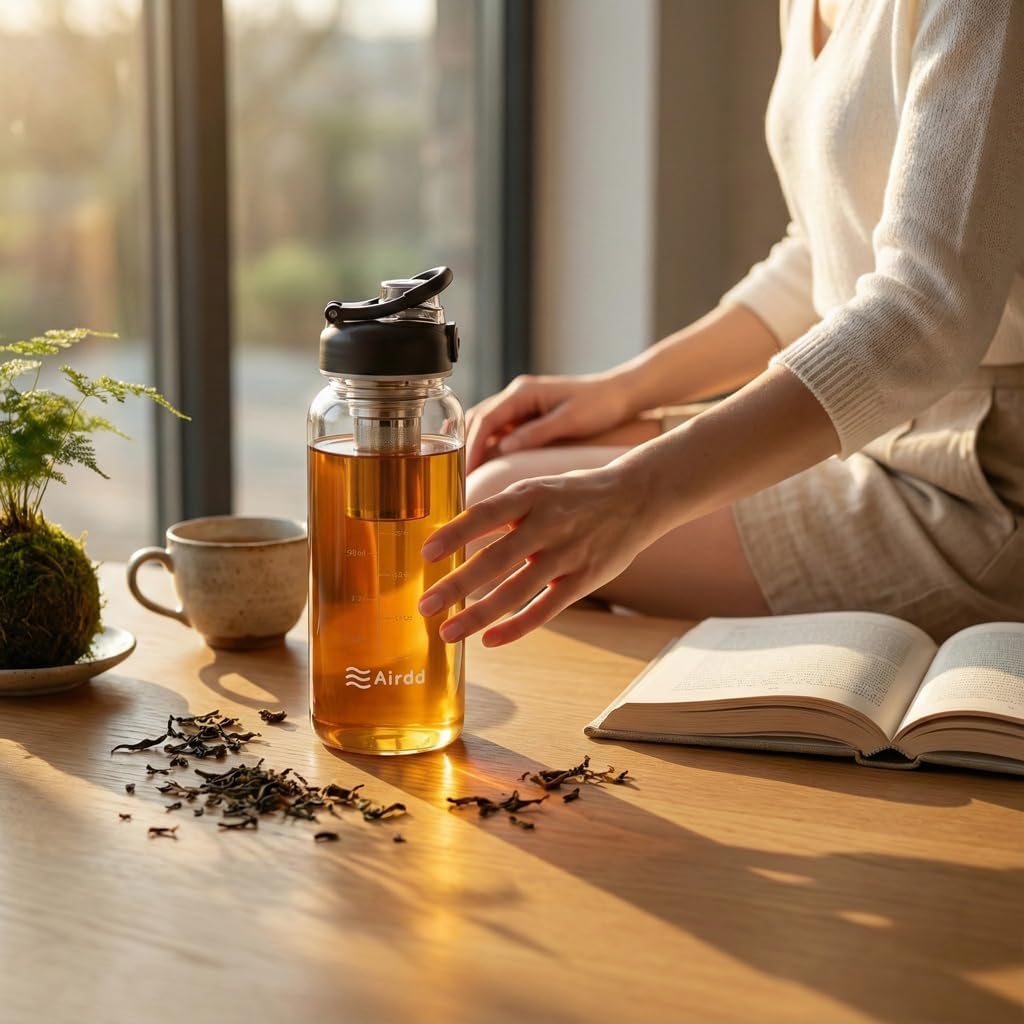
There’s a particular pleasure to loose-leaf tea. The way the leaves unfurl in hot water. The way the brew deepens over twenty minutes instead of three. The way it smells less like a vending machine and more like an actual leaf.
For most of us, that pleasure stays at home. It needs a teapot, a strainer, a quiet kitchen counter. The leaves stay in a jar on the shelf, and we end up reaching for another bag.
A glass water bottle with a built-in infuser changes the math. Suddenly the ritual fits in your bag. The leaves come with you. The 3 o’clock meeting tastes like first flush Darjeeling instead of yesterday’s lukewarm office cup.
This is a short, practical guide to actually doing it — water temperatures, steep times, common mistakes, and the cold-brew trick that’s quietly the best thing a wide-mouth bottle can do. Nothing precious. Nothing complicated.
What you’ll need
- A glass water bottle with a removable stainless infuser. We make one — the Airdd 32oz — but the method works with any wide-mouth, infuser-equipped bottle.
- 2 to 4 grams of loose-leaf tea per serving — roughly 1 to 2 teaspoons, depending on leaf size.
- Access to hot water. A kettle is ideal, but any office hot-water dispenser, café urn, or hotel-room coffee maker will do.
- Five minutes.
That’s the entire list. You don’t need a thermometer (we’ll show you the kettle-stage trick), and you don’t need to buy expensive tea — though good tea is genuinely worth the markup.
The basic method
- Heat your water to the temperature your tea wants. (Chart below.)
- Add tea to the infuser. A teaspoon is plenty for a 32oz bottle — leaves will expand to fill the space.
- Screw the infuser into the lid.
- Slip the neoprene sleeve over the bottle — before you pour. This is the one step nobody should skip with hot tea. Bare glass becomes painful to hold within seconds of boiling water going in. The sleeve insulates, cushions, and — most importantly — keeps the bottle safe to pick up. Treat it as a non-negotiable part of the brewing kit, not an accessory.
- Pour the hot water in. Fill until the water rises to about halfway up the infuser basket — enough to cover the tea leaves sitting at the bottom. You don’t need to fill to the rim; submerging the leaves is the whole job. The rest of the bottle stays empty for the steam. (Roughly the water level shown in the photo above.)
- Close the lid with the infuser submerged in the water.
- Steep. Set a phone timer. This part matters.
- Unscrew the infuser and remove it when the time’s up.
- Drink slowly. A 32oz bottle of tea is a 90-minute companion, not a shot.
The infuser-removal step is the one most people skip. It’s also the one that separates “actual tea” from “metallic, over-steeped regret.”
Water temperature: a cheat sheet
Different teas want different temperatures. Too-hot water turns delicate leaves astringent; water that’s too cool leaves bold leaves flat.
| Tea | Water temperature |
|---|---|
| White tea | 165–175°F |
| Green tea | 170–180°F |
| Oolong | 185–195°F |
| Black tea | 200–212°F |
| Pu-erh | 200–212°F |
| Herbal & tisanes | 200–212°F |
No thermometer? Use the kettle-stage trick:
- Whisper stage (the kettle starts to murmur) — about 170°F. Green tea.
- First boil (small bubbles cling to the bottom) — about 190°F. Oolong.
- Rolling boil (loud, persistent, throws steam) — 212°F. Black, herbal, pu-erh.
For green tea on a stovetop kettle, the easiest rule is: bring it to a full boil, then take the lid off and wait one full minute. That drops you neatly into the 170–180°F window.
Steep times
The most common mistake with loose-leaf-in-a-bottle is leaving the leaves in the entire time you’re drinking. That’s how a fresh oolong turns into something you’d rather pour out than finish.
| Tea | Steep time |
|---|---|
| White tea | 4–5 minutes |
| Green tea | 2–3 minutes |
| Oolong | 3–5 minutes |
| Black tea | 3–4 minutes |
| Pu-erh | 4–5 minutes |
| Herbal & tisanes | 5–7 minutes |
When the timer goes, unscrew the infuser, tap the wet leaves into the trash (or save them for a second steep — most good teas have a second life), give the infuser a quick rinse, and re-cap the bottle. What’s left is brewed tea that will stay drinkable for hours.
A small note: every tea brand prints slightly different times on the package. Trust the package over the chart — but trust your tongue over both.
The cold-brew trick
This is the move worth knowing. Cold-brew tea is wildly underrated, wildly easy, and a wide-mouth glass bottle is the ideal vessel for it.
- Add about 1.5 times your normal tea quantity to the infuser. (Cold extraction is gentler — you can afford more leaf.)
- Fill the bottle with cold, filtered water.
- Refrigerate overnight — 8 to 12 hours.
- Remove the infuser in the morning.
The result is smoother, sweeter, and far less bitter than its hot counterpart. No sugar needed. Green tea, white tea, and unflavored oolongs especially shine cold-brewed; black teas develop a quiet sweetness that doesn’t show up hot. It’s the way most serious tea drinkers handle summer.
If you’ve never tried it, start with a sencha or a jasmine green. You’ll wonder why anyone iced tea any other way.
Common mistakes
Pouring boiling water onto green tea. Bitter, vegetal, sad. Let the kettle rest 30 seconds first, or use the open-lid one-minute trick.
Stuffing the infuser full. Tea leaves expand — sometimes dramatically. Half-full leaves room for the leaves to unfurl and breathe.
Forgetting to remove the infuser. Brews past the steep window go astringent and metallic. Set a timer. Phone alarms exist for a reason.
Using grocery-store “loose-leaf” that’s actually broken dust. If the leaves look like the contents of a tea bag, you’ll get tea-bag tea. Buy from a tea shop, a roaster, or a reputable online vendor. The markup is real. So is the taste difference.
Reusing the same leaves all day. Wet leaves go off — especially in summer, especially in the sun. Empty the infuser at the end of the day. Tomorrow gets fresh ones.
Cleaning and care
Loose-leaf tea is forgiving of bottles. After the day’s last steep:
- Rinse the infuser under hot water; the wet leaves should fall out cleanly.
- Once a week, soak the infuser and bottle interior with a few drops of dish soap, or drop in a denture-cleaning tablet for ten minutes. Rinse well.
- A wide-mouth bottle is dishwasher-safe — place it on the top rack with the lid open.
- Avoid wire scrubbers on the glass. A long-handled bottle brush is all you need.
The neoprene sleeve does its quiet work in the background — it cushions the bottle against bumps, adds insulation so your tea stays warm longer, and gives your hand something to hold when the bottle’s hot.
The ritual
Brewing tea in a water bottle isn’t really about logistics. It’s about reclaiming a small ten-minute interval of your day from grab-and-go culture — turning a commute, a meeting break, an afternoon slump into something quieter, slower, and a little nicer to taste.
You’ll forget the timer sometimes. You’ll over-steep. You’ll get the water temperature wrong and watch a beautiful gyokuro turn into something less. That’s fine. Tomorrow gets a clean shot.
If you’re new to loose-leaf, start with a good black tea. They’re forgiving, they hold up to imperfect water, and they survive a hot commute. Once the rhythm becomes second nature, work your way toward oolongs and whites — they’ll reward the attention.
The Airdd 32oz Glass Water Bottle was designed for exactly this — stainless infuser, wide mouth, leakproof lid, neoprene sleeve that holds heat without holding it against your palm. Prime-eligible. Ships fast in the US.
Whichever bottle you carry, may there be tea in it for the long way around.